Just so you know – some links on this page are affiliate links. If you click and buy something, I may earn a small commission (think coffee money, not a luxury vacation) at no extra cost to you. I only share things I genuinely like and believe are worth it. Thanks for supporting this little corner of the internet – it really helps keep everything running.
Baseball has a way of outlasting the seasons it occupies. Long after a game ends, something from it stays — a phrase said in the dugout, a word from a manager who had seen it all, a quiet observation from someone who gave decades of their life to the diamond. The sport generates language the way it generates legend: slowly, repeatedly, and with a strange kind of permanence.
Part of what makes baseball so quotable is its pace. Unlike faster sports, baseball leaves space — between pitches, between innings, between the long stretches of a summer season. In that space, players and managers think, reflect, and sometimes say something that lands with the weight of lived experience. The game itself seems to invite a certain kind of honesty.
There is also the matter of failure. No other major sport is so openly built around not succeeding — where getting it right three times in ten tries earns a player genuine respect. That relationship with failure, and what it asks of a person, has produced some of the most quietly profound words in American sports. People who play baseball long enough tend to develop a particular clarity about patience and persistence.
The game also carries history with it in an unusually visible way. Names from generations past still echo through ballparks and conversations today. Babe Ruth, Jackie Robinson, Satchel Paige — these are figures who shaped more than the sport, and whose words carry the full weight of what they lived through. When baseball speaks, it often speaks in layers.
What strikes many people who follow the game closely is how often its most enduring insights have nothing to do with baseball at all. They are about time, about pressure, about showing up when it matters, about how you carry yourself when things go wrong. The diamond turns out to be a remarkably good classroom for all of this.
The quotes collected here span ten distinct themes — the love of the game, the mental demands it places on players, the lessons it teaches about life, and much more. They come from different eras and different corners of the sport, but they share a common quality: they feel true in a way that goes beyond the box score. That is what makes them worth sitting with.
The Love of the Game
Few things in American life have inspired the kind of devotion that baseball tends to produce in its followers. It is not always easy to explain to someone who does not feel it — this attachment to a sport that moves slowly, that builds across a long season, that asks for your attention across 162 games before it reveals anything conclusive. And yet, for those who love it, no explanation seems necessary.
The love of baseball is often a quiet thing. It tends to show up in small rituals — listening to a game on the radio, tracking a team through a summer, returning year after year to the same seat in the same park. It is a kind of loyalty that has less to do with winning than with belonging, less to do with drama than with continuity and the comfort of something that keeps returning.
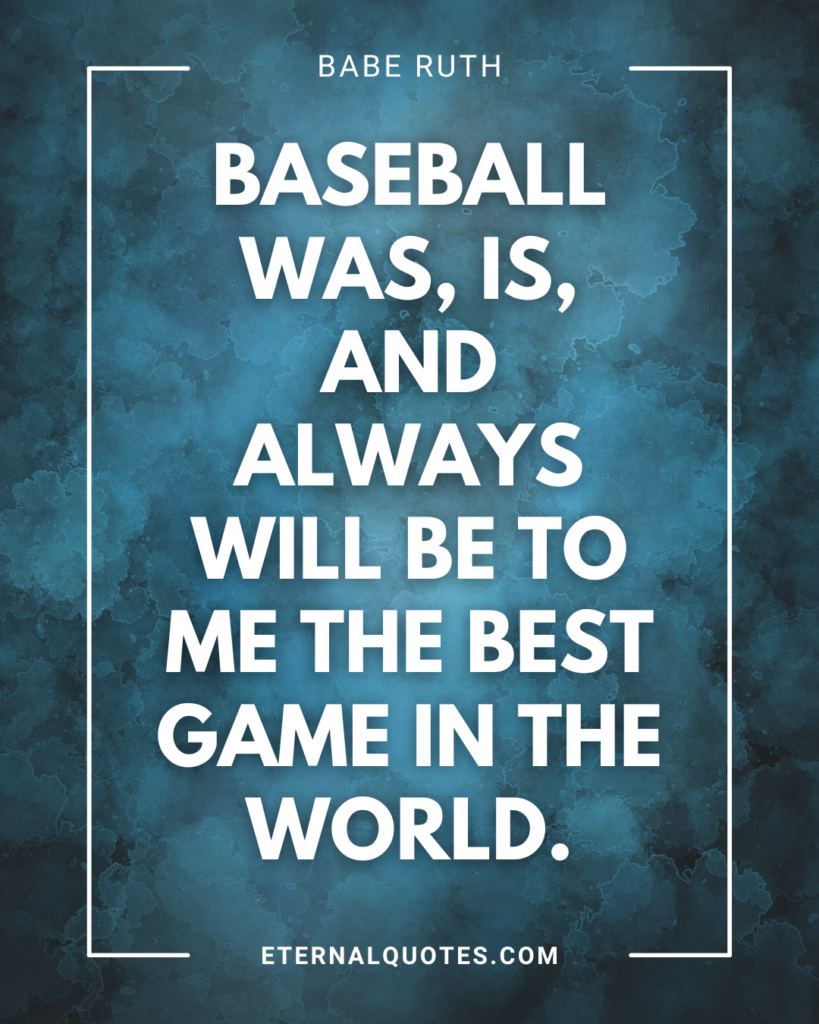
“There are three things in my life which I really love: God, my family, and baseball. The only problem is once baseball season starts, I change the order around a bit.” – Al Gallagher
“A baseball game is simply a nervous breakdown divided into nine innings.” – Earl Wilson
“Baseball is the only field of endeavor where a man can succeed three times out of ten and be considered a good performer.” – Ted Williams
“Baseball is like church. Many attend, few understand.” – Leo Durocher
“Baseball is like a poker game. Nobody wants to quit when he’s losing; nobody wants you to quit when you’re ahead.” – Jackie Robinson
“People ask me what I do in winter when there’s no baseball. I’ll tell you what I do. I stare out the window and wait for spring.” – Rogers Hornsby
“Baseball is a lot like life. It’s a day-to-day existence, full of ups and downs. You make the most of your opportunities in baseball as you do in life.” – Ernie Harwell
“Baseball is a harbor, a seclusion from failure that really matters, a playful utopia in which virtuosity can be savored to the third decimal place of execution.” – Mark Kramer
“The other sports are just sports. Baseball is a love.” – Bryant Gumbel
“In baseball, you can’t kill the clock. You’ve got to give the other man his chance. That’s why this is the greatest game.” – Earl Weaver
The Mental Game
Baseball tests the body, but it is relentless on the mind. A batter steps to the plate having failed more often than not across a long career, and must somehow clear all of that history and face the next pitch with full concentration. A pitcher has to hold competing information — the count, the runner, the batter’s tendencies, their own mechanics — while performing a physical act that leaves almost no margin for error. The mental load of the game is extraordinary and largely invisible.
What separates the good from the great in baseball is often not physical ability but mental resilience. The capacity to bounce back from a bad at-bat, to forget a difficult inning, to stay present in a long season that will include inevitable stretches of struggle — these are qualities that cannot be coached in the traditional sense. They develop slowly, through repetition and setback, and they tend to produce in players a particular kind of composure that carries well beyond the ballpark.
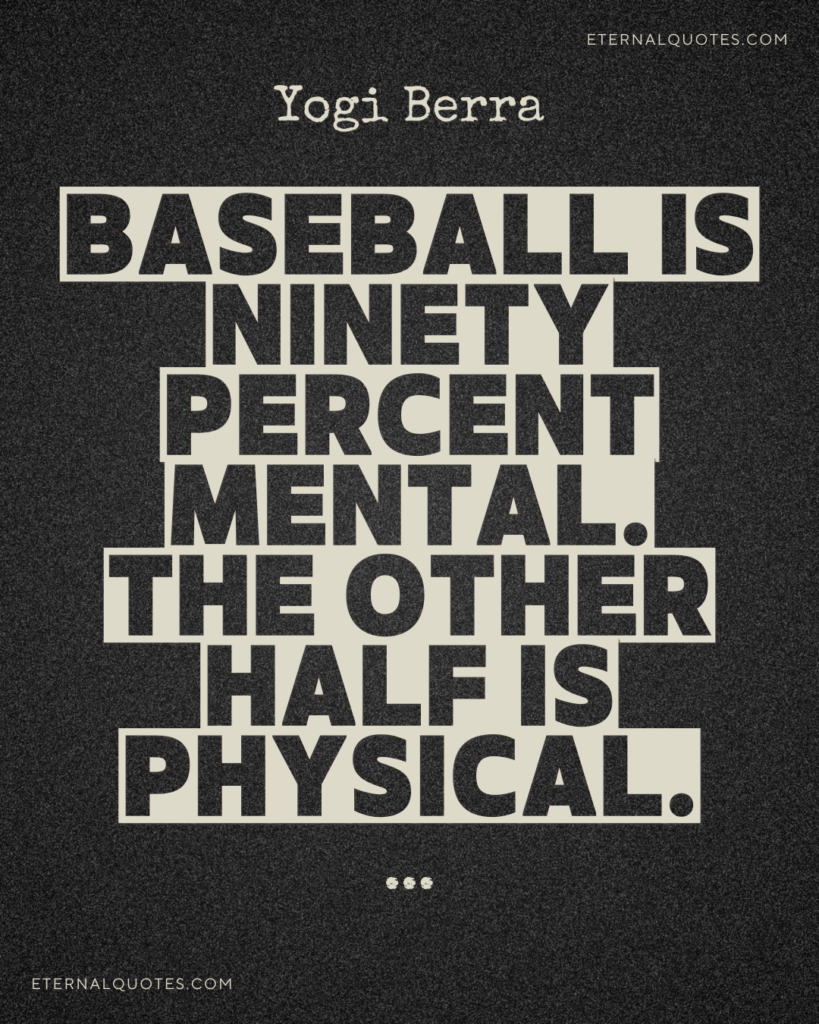
“How you respond to the challenge in the second half will determine what you become after the game, whether you are a winner or a loser.” – Lou Holtz
“The game isn’t over until it’s over.” – Yogi Berra
“Baseball is a game of inches and the most important are the six inches between your ears.” – Pat Borzi
“In playing ball, and in life, a person occasionally gets the opportunity to do something great. When that time comes, only two things matter: being prepared to seize the moment and having the courage to take your best swing.” – Hank Aaron
“Baseball is a game based on adversity. It’s a game that’s going to test you repeatedly. It’s going to find your weaknesses and your attitudes; it’s going to challenge your patience, your resilience, and your determination.” – Bob Feller
“The key to winning baseball games is pitching, fundamentals, and three-run homers.” – Earl Weaver
“I never blame myself when I’m not hitting. I just blame the bat and if it keeps up, I change bats. After all, if I know it isn’t my fault that I’m not hitting, how can I get mad at myself?” – Yogi Berra
“Baseball is about talent, hard work, and strategy. But at the deepest level, it’s about love, integrity, and respect.” – Pat Gillick
“I never questioned the integrity of an umpire. Their eyesight, yes.” – Leo Durocher
“The pitcher has got only a ball. I’ve got a bat. So the percentage in weapons is in my favor and I let the fellow with the ball do the fretting.” – Hank Aaron
Lessons from the Diamond
Baseball has a way of teaching things that are difficult to teach directly. Patience, perspective, the ability to fail without falling apart — these are not lessons that come from a coaching session or a team meeting. They arrive gradually, accumulated across hundreds of games, through seasons that include their share of genuine disappointment. The sport is an education in disguise, and those who play it long enough tend to recognize the classroom for what it is.
What the diamond offers is a kind of compressed experience of life’s rhythms — the long stretches where nothing seems to be going right, the unexpected turnaround, the moment where preparation and opportunity finally meet. Players who absorb these lessons carry them into everything that comes after, long after the last game has been played and the uniform put away for good.
“Never allow the fear of striking out keep you from playing the game.” – Babe Ruth
“It ain’t over till it’s over.” – Yogi Berra
“A life is not important except in the impact it has on other lives.” – Jackie Robinson
“The way a team plays as a whole determines its success. You may have the greatest bunch of individual stars in the world, but if they don’t play together, the club won’t be worth a dime.” – Babe Ruth
“Every strike brings me closer to the next home run.” – Babe Ruth
“There’s no crying in baseball!” – Jimmy Dugan (Tom Hanks) in “A League of Their Own”
“Baseball is a game where you can fail 70% of the time and still be considered a success.” – Anonymous
“You can’t think and hit at the same time.” – Yogi Berra
“When you come to a fork in the road, take it.” – Yogi Berra
“Little League baseball is a very good thing because it keeps the parents off the streets.” – Yogi Berra
The Perfect Swing
Hitting a baseball is widely regarded as one of the most difficult acts in professional sport. A round bat meeting a round ball traveling at speed, with spin and movement, in a split second — there is almost no room in the physics of it for anything less than precise timing and total commitment. Players spend entire careers in pursuit of something that can only be approximated, never quite perfected, which may be part of what makes the pursuit so consuming.
The great hitters tend to describe their craft in ways that reveal how much of it is internal — a feeling more than a formula, a kind of trained instinct that takes years to develop and can disappear without warning. Ted Williams made a science of it; others approached it almost as a meditative practice. What most agree on is that the perfect swing is less about force than about timing, less about trying than about trusting what years of repetition have put into the body.
“Don’t look back. Something might be gaining on you.” – Satchel Paige
“Hitting is fifty percent above the shoulders.” – Ted Williams
“They give you a round bat and they throw you a round ball and they tell you to hit it square.” – Willie Stargell
“Hitting is timing. Pitching is upsetting timing.” – Warren Spahn
“In baseball, my theory is to strive for consistency, not to worry about the numbers. If you dwell on statistics you get shortsighted; if you aim for consistency, the numbers will take care of themselves.” – Tom Seaver
“Swing hard, in case they throw the ball where you’re swinging.” – Duke Snider
“A man has to have goals – for a day, for a lifetime – and that was mine, to have people say, ‘There goes Ted Williams, the greatest hitter who ever lived.'” – Ted Williams
“I swing big, with everything I’ve got. I hit big or I miss big. I like to live as big as I can.” – Babe Ruth
“Good pitching will always stop good hitting and vice-versa.” – Casey Stengel
“Wait until the ball is in the strike zone, then kill it.” – Ted Williams
The Art of Pitching
Pitching occupies a singular position in baseball — isolated, exposed, responsible. When things go wrong on the mound, there is nowhere to look but inward, no teammate to absorb the blame, no play that unfolds without the pitcher’s involvement first. It demands a combination of physical precision and psychological steadiness that few athletes in any sport are asked to sustain over a long career. The ones who manage it for a decade or more tend to have an almost philosophical relationship with failure and pressure.
The craft of pitching, at its most refined, is less about overpowering a hitter than about outsmarting one. Location, sequence, tempo, deception — these are the real tools of the effective pitcher, and they take longer to develop than raw velocity. Some of the most dominant pitchers in history did their best work not by throwing harder but by thinking more clearly, by understanding what a hitter expected and then quietly delivering something else.
“He’s got to sit over there and know it’s all his fault.” – Whitey Herzog on the loneliness of the pitcher
“I became a good pitcher when I stopped trying to make them miss the ball and started trying to make them hit it.” – Sandy Koufax
“In pitching, as in life, you’re constantly making adjustments.” – Mike Pelfrey
“No matter how good you are, you’re going to lose one-third of your games. No matter how bad you are, you’re going to win one-third of your games. It’s the other third that makes the difference.” – Tommy Lasorda
“Momentum? Momentum is the next day’s starting pitcher.” – Earl Weaver
“I don’t want to throw too many perfect games. Then everybody will expect it.” – Orel Hershiser
“People think I was born with a silver spoon in my mouth just because I could throw a 95 mph fastball, but that wasn’t the case.” – Nolan Ryan
“You have to have a catcher because if you don’t you’re likely to have a lot of passed balls.” – Casey Stengel
“Pitching is simple — keep the ball away from the bat.” – Satchel Paige
“The key to being a good pitcher is to work fast, change speeds, and throw strikes.” – Nolan Ryan
The Manager’s Wisdom
Managing a baseball team is an exercise in sustained judgment — hundreds of small decisions across a season, most of them made without the luxury of certainty. A manager cannot play the game themselves. They can only set the conditions, make the calls, and trust that what they have built in the weeks and months before will hold when the pressure arrives. It is a role that rewards patience and clarity of mind above almost everything else.
The great managers tend to be students of human nature as much as students of the game. They understand that each player is different — that what motivates one person might deflate another, that the same situation can mean entirely different things depending on who is facing it. Managing the personalities in a clubhouse across a 162-game season is, in many ways, a harder task than managing the tactics on the field.
“The best possible thing in baseball is winning the World Series. The second best thing is losing the World Series.” – Tommy Lasorda
“I always got nervous before a game, but I found that if I kept myself busy, I was okay. What I would do is make sure every one of my teammates was ready. When I had done that, I was ready.” – Sparky Anderson
“Good teams became great ones when the members trust each other enough to surrender the ‘me’ for the ‘we.'” – Phil Jackson
“You can’t just beat a team, you have to leave a lasting impression in their minds so they never want to see you again.” – Mia Hamm
“Baseball is a simple game. If you have good players and if you keep them in the right frame of mind, the manager is a success.” – Joe McCarthy
“I believe in rules. Sure I do. If there weren’t any rules, how could you break them?” – Leo Durocher
“A manager has his cards and plays the ones he can in different situations.” – Tony La Russa
“A baseball manager is a necessary evil.” – Sparky Anderson
“I don’t want to embarrass any other catcher by comparing him to Johnny Bench.” – Sparky Anderson
“They say the first mistake was when they took me out of the Bronx. I say the first mistake was when they put me in the Bronx.” – Casey Stengel
The Player’s Journey
A baseball career is a long road by the standards of professional sport. Players begin young, often in the low minors, and spend years developing in relative obscurity before — if things go well — they reach the major leagues and find themselves playing in front of thousands of people in parks that feel nothing like the fields where they first learned the game. That journey shapes a person in ways that are hard to fully articulate but that tend to leave permanent marks.
Along the way, the game takes things from players as surely as it gives them — youth, time, the physical certainty of early years. What remains, for those who have given a significant portion of their lives to it, is something harder to name: a way of carrying themselves, a particular relationship with effort and disappointment, and a sense of having belonged to something larger than any individual moment or achievement.
“A man has to have goals – for a day, for a lifetime – and that was mine, to have people say, ‘There goes Ted Williams, the greatest hitter who ever lived.'” – Ted Williams
“I was such a dangerous hitter I even got intentional walks during batting practice.” – Casey Stengel
“People who throw kisses are hopelessly lazy.” – Bob Hope
“You spend a good piece of your life gripping a baseball, and in the end it turns out that it was the other way around all the time.” – Jim Bouton
“Baseball is the only field of endeavor where a man can succeed three times out of ten and be considered a good performer.” – Ted Williams
“I don’t compare ’em, I just catch ’em.” – Yogi Berra on the differences between Joe DiMaggio and Mickey Mantle
“I was born to play baseball.” – Roberto Clemente
“When I was a small boy in Kansas, a friend of mine and I went fishing and as we sat there in the warmth of the summer afternoon on a river bank, we talked about what we wanted to do when we grew up. I told him that I wanted to be a real major league baseball player, a genuine professional like Honus Wagner. My friend said that he’d like to be President of the United States. Neither of us got our wish.” – Dwight D. Eisenhower
“I’d walk through hell in a gasoline suit to play baseball.” – Pete Rose
“The ballplayer who loses his head, who can’t keep his cool, is worse than no ballplayer at all.” – Lou Gehrig
Baseball and America
Baseball grew alongside America in a way that no other sport quite did. It was played in the years after the Civil War, during the waves of immigration that transformed American cities, through two world wars, through the civil rights movement, through every decade of social and economic change that followed. The sport was never separate from those events — it absorbed them, reflected them, and sometimes pushed back against them in ways that mattered.
What has kept baseball woven into the American story is not just its longevity but its geography. It is played in ballparks that exist in every kind of city and town, by players who come from vastly different backgrounds and places. The game has always been a meeting point — between regions, between generations, between people who might not have found another context to share. That quality of gathering, of showing up to the same place for the same thing, runs deep in American life.
“Baseball is a game, yes. It is also a business. But what it most truly is, is disguised combat. For all its gentility, its almost leisurely pace, baseball is violence under wraps.” – Willie Mays
“Baseball is America’s pastime, but football is truly America’s passion.” – Michael Wilbon
“One of the beautiful things about baseball is that every once in a while you come into a situation where you want to, and where you have to, reach down and prove something.” – Nolan Ryan
“The one constant through all the years, Ray, has been baseball. America has rolled by like an army of steamrollers. It has been erased like a blackboard, rebuilt and erased again. But baseball has marked the time.” – Terence Mann (James Earl Jones) in “Field of Dreams”
“Baseball is a game dominated by vital ghosts; it’s a fraternity, like no other we have of the active and the no longer so, the living and the dead.” – Richard Gilman
“Baseball is part of America’s DNA. It’s a game that embodies the American spirit of grit, determination, and teamwork.” – Barack Obama
“Baseball is a skilled game. It’s America’s game – it, and high taxes.” – Will Rogers
“You can’t sit on a lead and run a few plays into the line and just kill the clock. You’ve got to throw the ball over the damn plate and give the other man his chance. That’s why baseball is the greatest game of them all.” – Earl Weaver
“Baseball is almost the only orderly thing in a very unorderly world. If you get three strikes, even the best lawyer in the world can’t get you off.” – Bill Veeck
“Football is to baseball as blackjack is to bridge. One is the quick jolt; the other the deliberate, slow-paced game of skill. One is climactic, the other pregnant with expectation.” – George Will
Humor on the Diamond
Baseball has always had a particular relationship with humor. The long season creates it — 162 games across six months means that even the most serious competitors have to find ways to stay loose, and dugout culture has produced its own kind of comedy that rarely makes the box scores but lives vividly in the memories of anyone who spent time around the game. The sport does not take itself quite as solemnly as it sometimes appears from the outside.
Much of the humor that emerges from baseball has an accidental quality to it — an offhand remark that lands perfectly, a moment of absurdity that gets repeated until it becomes legend. Yogi Berra built an entire reputation around statements that seemed to contradict themselves but somehow made more sense than anything else you could say. Casey Stengel’s press conferences were their own form of theater. The game has always made room for the comic alongside the serious, and the sport is richer for it.
“I think I’m telling the truth. I sat by my window all day today and I watched the game. The Yankees won, 5-4.” – Casey Stengel, when asked by a player if the team was playing that day
“I watched a lot of baseball growing up, and I just remember being hit with the crack of the bat. The sound of the bat on the ball is amplified so much now.” – David Spade
“We need a designated hitter for the pitchers, just like we need a designated driver for the drinkers.” – Jay Leno
“Why does everybody stand up and sing ‘Take Me Out to the Ball Game’ when they’re already AT the ball game?” – Larry Anderson
“I used to say of him that his presence on the field made the rest of the team feel better. That’s what an ace pitcher is supposed to do. He’s the one everyone looks up to. He’s the one who can stopper losing streaks and prolong winning streaks. He’s the one the other players want to have out there.” – Bruce Hurst on Roger Clemens
“All right everyone, line up alphabetically according to your height.” – Casey Stengel
“Bob Gibson is the luckiest pitcher I ever saw. He always pitches when the other team doesn’t score any runs.” – Tim McCarver
“I think about baseball when I wake up in the morning. I think about it all day and I dream about it at night. The only time I don’t think about it is when I’m playing it.” – Carl Yastrzemski
“It took me seventeen years to get three thousand hits in baseball. I did it in one afternoon on the golf course.” – Hank Aaron
“The great thing about baseball is when you’re done, you’ll only tell your grandchildren the good things. If they ask me about 1989, I’ll tell them I had amnesia.” – Sparky Anderson
The Magic of the Game
Ask anyone who loves baseball to explain what makes it magical and they will often struggle to give a simple answer. It is not any single thing — not the crowd, not the crack of a bat, not the geometry of the field. It is something more cumulative than that, something that builds across years of watching and attending and remembering. The magic of baseball is not dramatic so much as it is quietly persistent, the way certain things lodge themselves in memory without announcing their arrival.
Part of the magic is generational. Baseball passes from one person to another — a parent explaining the infield fly rule, a grandparent telling stories about players long retired, a child discovering for the first time the particular pleasure of a summer afternoon spent at the ballpark. The game carries those moments with it. Every fan who loves baseball is, in some sense, the inheritor of someone else’s love, and will one day pass it along to someone else in turn.
“The magic of baseball isn’t just on the field; it’s in the sounds, the smells, and the memories.” – Ken Burns
“You should enter a ballpark the way you enter a church.” – Bill Lee
“A ball player’s got to be kept hungry to become a big leaguer. That’s why no boy from a rich family ever made the big leagues.” – Joe DiMaggio
“A baseball field must be the most beautiful thing in the world. It’s so honest and precise. And we play on it. Every star gets humbled. Every mediocre player has a great moment.” – Bud Harrelson
“Baseball is a ballet without music. Drama without words.” – Ernie Harwell
“Poets are like baseball pitchers. Both have their moments. The intervals are the tough things.” – Robert Frost
“It seems like baseball is made for fathers and sons. That’s how you learn the game, and that’s how the game passes from generation to generation.” – Buck O’Neil
“Baseball is not a conventional industry. It belongs neither to the players nor management, but to all of us. It is our national pastime, our national symbol, and our national treasure.” – A. Bartlett Giamatti
“There’s nothing like Opening Day. There’s nothing like the start of a new season. I started playing baseball when I was seven years old and quit playing when I was 40, so it’s kind of in my blood.” – George Brett
“For a pitcher, baseball is a simple game. Throw strikes. Home plate don’t move.” – Satchel Paige
What the Game Leaves Behind
Baseball endures not because it is the most exciting sport or the most lucrative or the easiest to follow, but because it has managed to mean something to successive generations in ways that go well beyond the wins and losses. The words that the game has produced — from dugouts and press boxes and post-game interviews and quiet moments of reflection — have accumulated into something that feels more like a body of literature than a collection of sports quotes. That is unusual, and worth acknowledging.
The themes that run through the best of these words are not really about baseball at all. They are about failure and resilience, about the gap between effort and outcome, about what it means to show up every day for something that will not always reward you. These are the concerns of a full human life, and baseball has simply provided a concentrated and visible stage on which to work them out.
What makes a quote last is that it captures something true without overstating it. The best baseball voices — Yogi Berra with his accidental wisdom, Jackie Robinson with his hard-earned clarity, Satchel Paige with his laconic perspective — shared a quality of saying exactly as much as needed and no more. They were not trying to be memorable. They were simply speaking from experience, and the experience was real enough to carry the words forward.
Generations of fans have found in baseball a kind of consistency that the rest of life does not always provide. The season returns each spring with a reliability that borders on comfort. The rules do not change. The field is the same ninety feet between bases it has always been. In a world that shifts constantly, that steadiness is not a small thing — it is the reason people keep coming back, year after year, long after the players they first loved have retired and the parks they first visited have been rebuilt.
The quotes in this collection come from different eras and different corners of the sport, but they share a common thread: a willingness to take the game seriously as a source of genuine insight. Not to inflate it, not to make it into something it is not, but to look honestly at what it offers — the competition, the failure, the teamwork, the long arc of a season — and to find in those things a reflection of something larger. That is what the best baseball voices have always done.
The game keeps writing itself forward. New players arrive, new moments accumulate, new words get said that will be repeated for decades. Baseball’s relationship with language is one of its most underappreciated qualities — the sport generates wisdom the way it generates statistics, steadily and over a very long time. Whatever the next generation takes from it, the record of what has already been said is more than enough to sit with, to return to, and to find something new in each time.