

Just so you know – some links on this page are affiliate links. If you click and buy something, I may earn a small commission (think coffee money, not a luxury vacation) at no extra cost to you. I only share things I genuinely like and believe are worth it. Thanks for supporting this little corner of the internet – it really helps keep everything running.
Sibling relationships begin before we have the words to explain them. They take shape in shared rooms, small arguments, copied habits, and the ordinary routines that end up mattering more than anyone expects. A brother or sister is often the first person who teaches you what closeness feels like when it is mixed with frustration, loyalty, comfort, and pride. It is rarely simple, which is part of what makes it last.
Family life has a way of pressing people together in both tender and uncomfortable ways. You grow up side by side without choosing each other, and yet over time that very lack of choice can create a strange kind of trust. You know each other’s moods, weaknesses, and patterns long before adulthood asks either of you to explain yourselves. That history stays in the background, even after life becomes fuller and more separate.
Not every sibling bond looks warm on the surface. Some are loud, teasing, defensive, competitive, or awkward in ways outsiders do not always understand. But even relationships that carry tension often hold a deep familiarity underneath. There is something lasting about being shaped by the same household, the same voices, and many of the same turning points.
As the years pass, the meaning of that connection often changes. Childhood roles soften, old irritations lose their sharpness, and the things that once felt huge start to look smaller from a distance. What remains is the knowledge that someone else remembers where you came from. In a world where people know only pieces of you, that kind of memory can feel grounding.
Siblings also carry a quiet record of who we have been. They remember the early versions of us, the phases we outgrew, the mistakes we would rather forget, and the moments that revealed who we were becoming. That can feel exposing at times, but it can also feel comforting. There is relief in being known beyond whatever role you are trying to play now.
Some sibling relationships grow close early and stay that way. Others take years to settle into something gentler, steadier, and more honest. Either way, they tend to leave a mark that runs deep because they belong to the foundation of a person’s life. They are part of the first world we knew, and in many quiet ways, they continue to shape how we move through the rest of it.
Unbreakable Bonds
Some connections feel steady even when life around them changes shape. The bond between siblings often belongs to that category because it is built over years, not moments. It grows through repetition, shared routines, and the small ways people keep returning to one another. Even when the relationship is imperfect, that sense of belonging can remain surprisingly strong.
What makes this kind of bond lasting is not that it is always smooth, but that it survives so many versions of both people. Childhood, distance, maturity, disappointment, and forgiveness all leave their marks. Still, certain ties hold because they were formed close to the beginning of life, before anyone knew how much those early years would matter. That history becomes its own kind of anchor.
Siblings: the only people who know exactly how crazy your parents are.
The greatest gift our parents gave us was each other.
In the cookies of life, siblings are the chocolate chips.
Side by side or miles apart, siblings are always connected by heart.
A sibling is a piece of childhood that can never be lost.
Brothers and sisters separate to follow their paths, but they never forget their roots.
Like branches on a tree, we all grow in different directions, yet our roots remain as one.
Siblings know when to push your buttons and when to give you a hug.
The beauty of siblings is that they remember the times you want to forget.
Siblings: your first friend, your first enemy, and your forever ally.
Growing Up Together
Growing up with a sibling means your childhood is never held by one memory alone. Another person was there for the same house, the same rules, the same strange family moments, and the same changing seasons of growing up. Even when you remember things differently, that shared beginning creates a kind of private landscape. It becomes part of how both of you make sense of where you came from.
Time changes the details, but it rarely erases the feeling of having been raised alongside someone who saw it all unfold. The games, the arguments, the boredom, the rituals, and the embarrassments become woven together over time. Later in life, those early years often feel more meaningful than they did while they were happening. What once seemed ordinary starts to look like the foundation of something lasting.
Having a sibling means having a witness to your childhood – for better or worse.
We may have started as rivals, but we grew up to be best friends.
Sibling relationships outlast marriages, survive the death of parents, resurface after quarrels that would sink friendships.
Our shared childhood created a tapestry of memories only we understand.
To grow up with siblings is to know the importance of sharing, negotiating, and occasionally plotting revenge.
Years may wrinkle the skin, but to give up enthusiasm for your sibling wrinkles the soul.
We didn’t realize we were making memories; we just knew we were having fun.
From building blanket forts to building our own lives, you’ve been there through it all.
Childhood wouldn’t have been complete without a sibling to blame things on.
The laughter we shared as kids still echoes in the halls of my memory.
Brother-Sister Relationships
Brother-sister relationships often carry a little more contrast on the surface. The differences in temperament, expression, or role can make the connection feel both close and unpredictable. One moment it may look like irritation, and the next it turns into instinctive care. That blend of tension and loyalty gives the relationship much of its depth.
What makes it memorable is often the way each person becomes a familiar opposite. A brother may bring challenge, noise, or bluntness, while a sister may bring reflection, softness, or fierce honesty, though those roles can shift in any direction. Over time, both people often end up shaping one another more than they realize. The result is a bond that can feel both deeply personal and strangely balanced.
Brothers and sisters are as close as hands and feet.
A sister can be seen as someone who is both ourselves and very much not ourselves—a special kind of double.
To the outside world, we all grow old. But not to brothers and sisters. We know each other as we always were.
A brother may challenge you, but a sister sees beyond your flaws.
Sisters and brothers just happen to be connected by blood. Best friends are chosen.
When sisters stand shoulder to shoulder, who stands a chance against us?
A brother is a protector and a guide, but a sister is a mirror and a friend.
No one irritates you more than your brother, and no one defends you faster than your sister.
Brother and sister separated by distance, joined by love.
A brother’s love is disguised in teasing, a sister’s in nagging.
Sibling Rivalry
Rivalry is often one of the earliest forms closeness takes between siblings. It can be petty, dramatic, funny, and exhausting, sometimes all in the same afternoon. Beneath the competition, there is often a need to be seen, respected, or understood within the same small world. That is part of why even ordinary disagreements can feel so intense.
With time, rivalry often looks less like a problem and more like a rough-edged form of intimacy. It teaches people how to push back, how to recover, and how to live alongside differences that will not disappear. The arguments may be real, but so is the attachment underneath them. Very few people can annoy you so deeply while still feeling like home.
We fought like cats and dogs, but no one else better try to fight either of us.
Siblings that argue are still siblings that care.
Fighting with your sibling is like being in the Hunger Games – may the odds be ever in your favor.
My sibling and I can go from mortal enemies to best friends in 3.5 seconds.
Siblings: nature’s way of teaching you conflict resolution before you enter the real world.
We spent half our childhood trying to kill each other and the other half defending each other.
Love your sibling enough to admit when they actually win an argument.
Sibling rivalry is just another form of caring deeply about each other.
Competing with your sibling teaches you that second place is just the first loser.
Nothing tests your patience like sharing a bathroom with your sibling.
Older Siblings
Older siblings often step into their role before they understand what it asks of them. They are watched closely, copied without permission, and quietly expected to know more than they actually do. Sometimes that creates confidence, and sometimes it creates pressure that stays hidden behind jokes or authority. Either way, being first leaves its own mark.
That position often brings a mix of protectiveness and impatience. Older siblings may lead, tease, warn, or interfere, sometimes all while trying to figure themselves out. Their influence tends to show up in practical ways as much as emotional ones. Even when the role softens with age, it often remains part of the shape of the relationship.
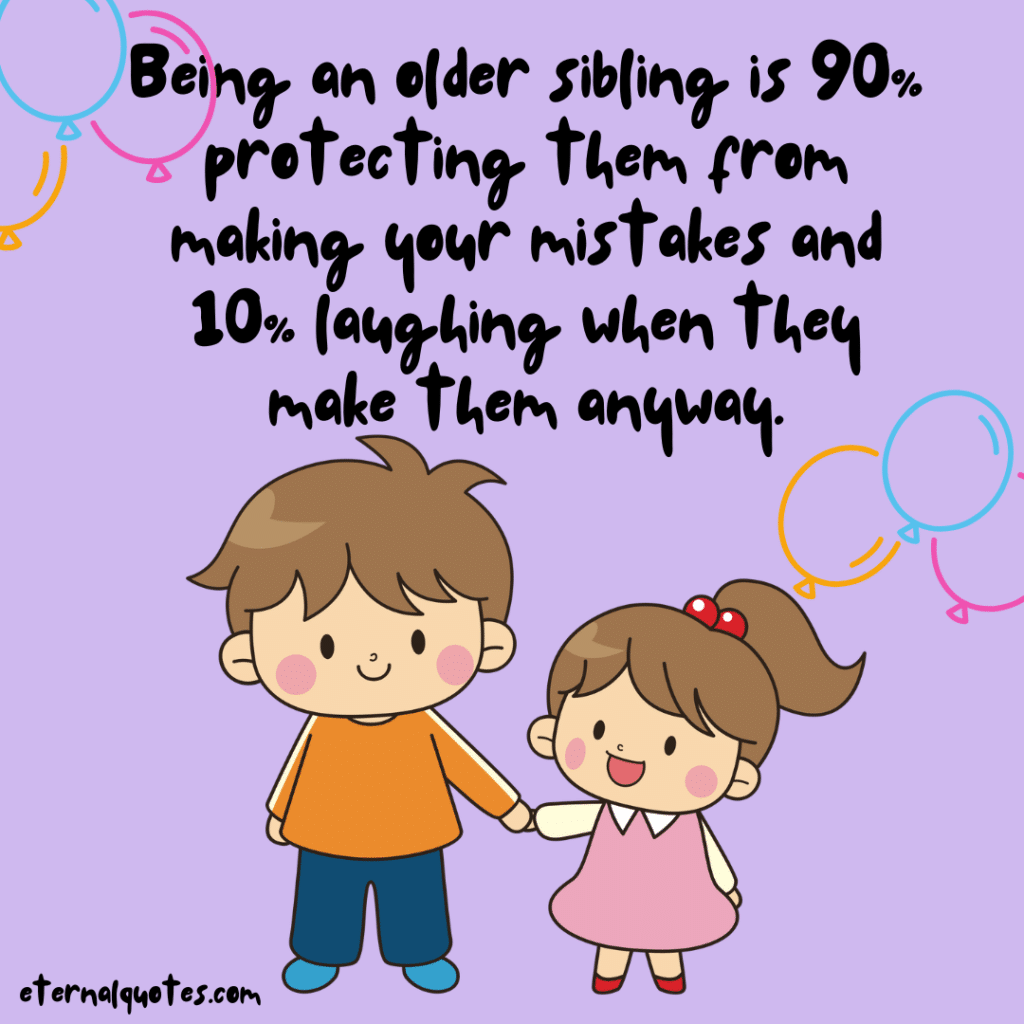
The older sibling serves as both an example and a warning.
As an older sibling, I’ve mastered the art of stealing food from my sibling’s plate while they’re not looking.
Older siblings: professional rule-breakers so you could have it easier.
Nobody can get away with criticizing my sibling except me.
Being an older sibling means giving advice you never followed yourself.
I may be the oldest, but I still have a lot to learn from my younger siblings.
The greatest gift to a younger sibling is having an older one who already broke all the rules.
As the older sibling, I’m obligated to embarrass you in front of your friends.
I’m not bossy. I’m the oldest and therefore, I’m always right.
Being the older sibling means always having someone who looks up to you, even when you’re not at your best.
Younger Siblings
Younger siblings often grow up in the shadow of people who arrived first, which gives them a sharp eye for how family dynamics work. They learn what has already been tested, what can be challenged, and where the gaps are. That position can make them adaptable, playful, and unexpectedly observant. Being younger is not only about receiving attention, but also about learning how to claim space.
There is usually a mix of freedom and frustration in that role. The youngest may be underestimated, fussed over, or treated as if time has not moved on, even long after adulthood begins. Yet that same role often builds resilience and personality in quiet ways. It teaches a person how to speak up, negotiate, and turn limitation into style.
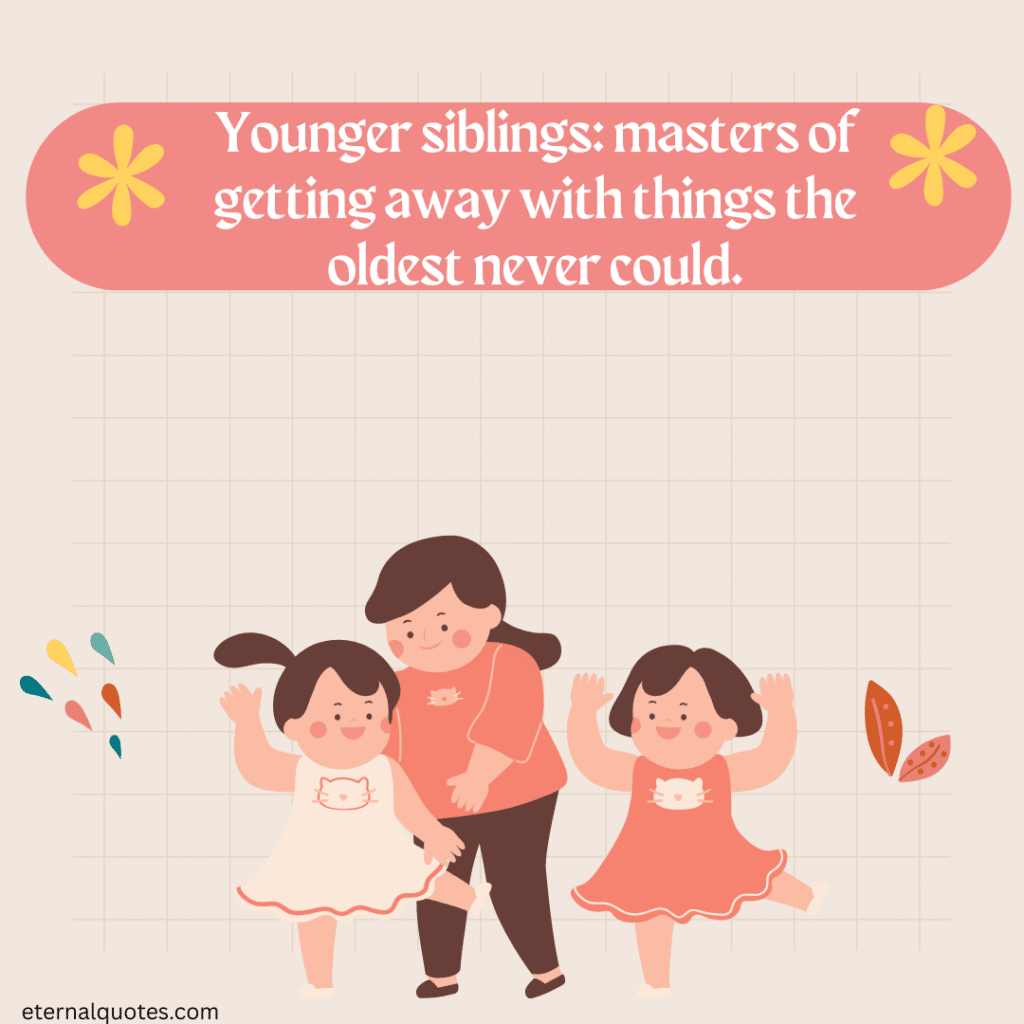
Being the younger sibling means inheriting clothes, toys, and all the blame.
Younger siblings have a PhD in pushing buttons and getting away with it.
Being the youngest taught me how to negotiate, manipulate, and eventually dominate.
The youngest sibling: observes everyone’s mistakes and still makes them anyway.
As the youngest, I learned early on how to be heard in a crowd.
Youngest siblings are the most creative because they’ve spent their lives finding workarounds.
Being the youngest means having multiple parents in the form of bossy older siblings.
The advantage of being the youngest is having siblings who already made all the mistakes.
Younger siblings are born with the gift of persuasion.
Being the youngest means you’re the baby of the family forever, even when you’re 50.
Support System
Support from a sibling often feels different from support offered anywhere else. It carries history with it, along with a level of recognition that does not need much explanation. When life becomes complicated, that familiarity can be more comforting than perfect advice. Sometimes what steadies a person most is simply being understood by someone who has seen the same roots.
This kind of support is not always sentimental or polished. It may come through a blunt conversation, a badly timed joke, an unexpected favor, or a phone call that begins without ceremony. What matters is the sense that someone is there in a way that feels durable. In difficult seasons, that kind of presence can mean more than people know how to say.
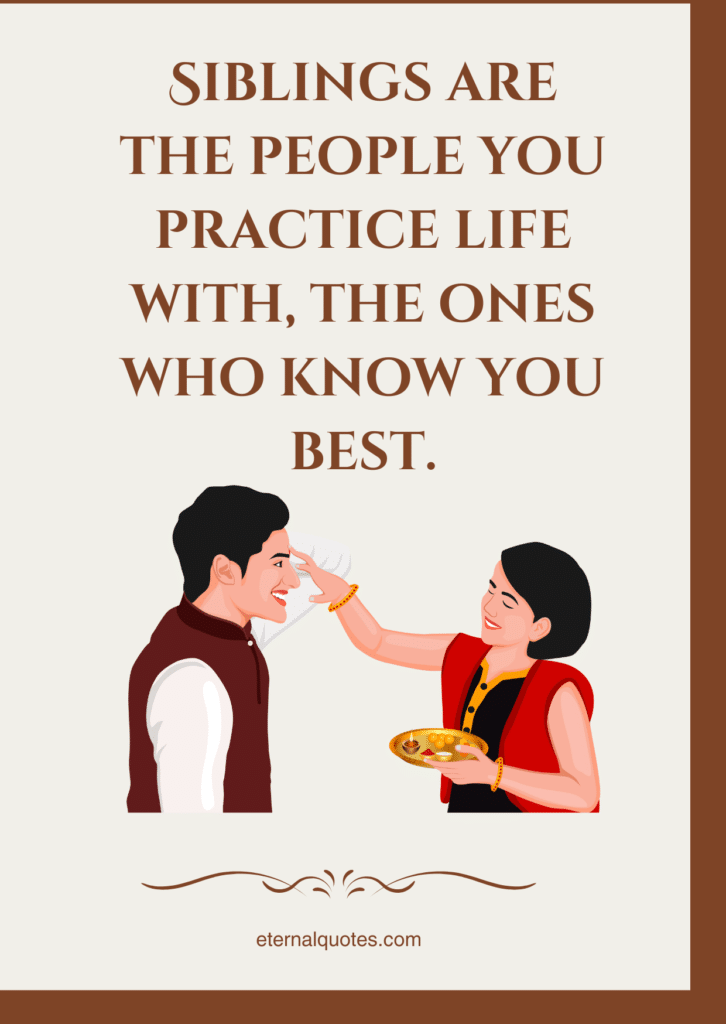
When life gets tough, you realize your sibling is your built-in best friend.
A sibling’s shoulder is the perfect place to lean on when the world becomes too heavy.
In the storm of life, siblings are your shelter.
You don’t choose your siblings, but they become your chosen support system.
No one understands your strange family like your sibling does.
Having a sibling means never having to explain your weird childhood references.
When parents don’t understand, siblings usually do.
Siblings: your emergency contact, your kidney donor, your 2 AM phone call.
A sibling knows exactly when to give advice and when to just listen.
The best therapist has fur, four legs, and a wagging tail. The second best is a sibling who’s been there.
Sibling Wisdom
Siblings teach each other lessons that are not usually planned or gentle. Much of that wisdom comes through friction, honesty, and the ordinary difficulty of learning to live close to another person. It begins early, often before anyone has the maturity to name what is happening. Still, those lessons tend to stay because they are learned in real life rather than theory.
Some of that wisdom is practical, and some of it is emotional. Siblings can teach patience, forgiveness, boundaries, resilience, and the uncomfortable truth that love does not always look soft. They reveal things about pride, fairness, and loyalty in ways that feel immediate. Even the hard parts can end up shaping a person into someone steadier and more aware.

Siblings teach you that life isn’t fair, and that’s a valuable lesson.
Your sibling knows exactly which button to push, but also exactly what you need to hear.
A sibling’s honesty is brutal but necessary.
Nothing teaches patience like waiting for your sibling to finish in the bathroom.
Siblings are the first people to teach you that the world doesn’t revolve around you.
The wisdom of siblings: they know when to fight for you and when to let you fall.
My sibling taught me that forgiveness is not optional in the closest relationships.
A sister’s advice comes with love; a brother’s advice comes with protection.
Siblings teach you to share early, so adulthood feels less difficult.
Sometimes the wisest thing my sibling taught me was what NOT to do.
Humor & Mischief
Humor is often one of the oldest languages siblings share. It begins in small rebellions, repeated jokes, ridiculous arguments, and the strange ability to make each other laugh at the worst possible time. Much of it makes no sense outside the relationship, which is part of why it feels so personal. Shared mischief has a way of turning ordinary childhood into family folklore.
Even in adulthood, that humor can remain one of the quickest ways back to closeness. A certain look, phrase, or memory is sometimes enough to collapse years of distance in a moment. Laughter does not erase difficulty, but it can soften it. In many sibling relationships, comedy becomes one of the quiet ways affection survives.
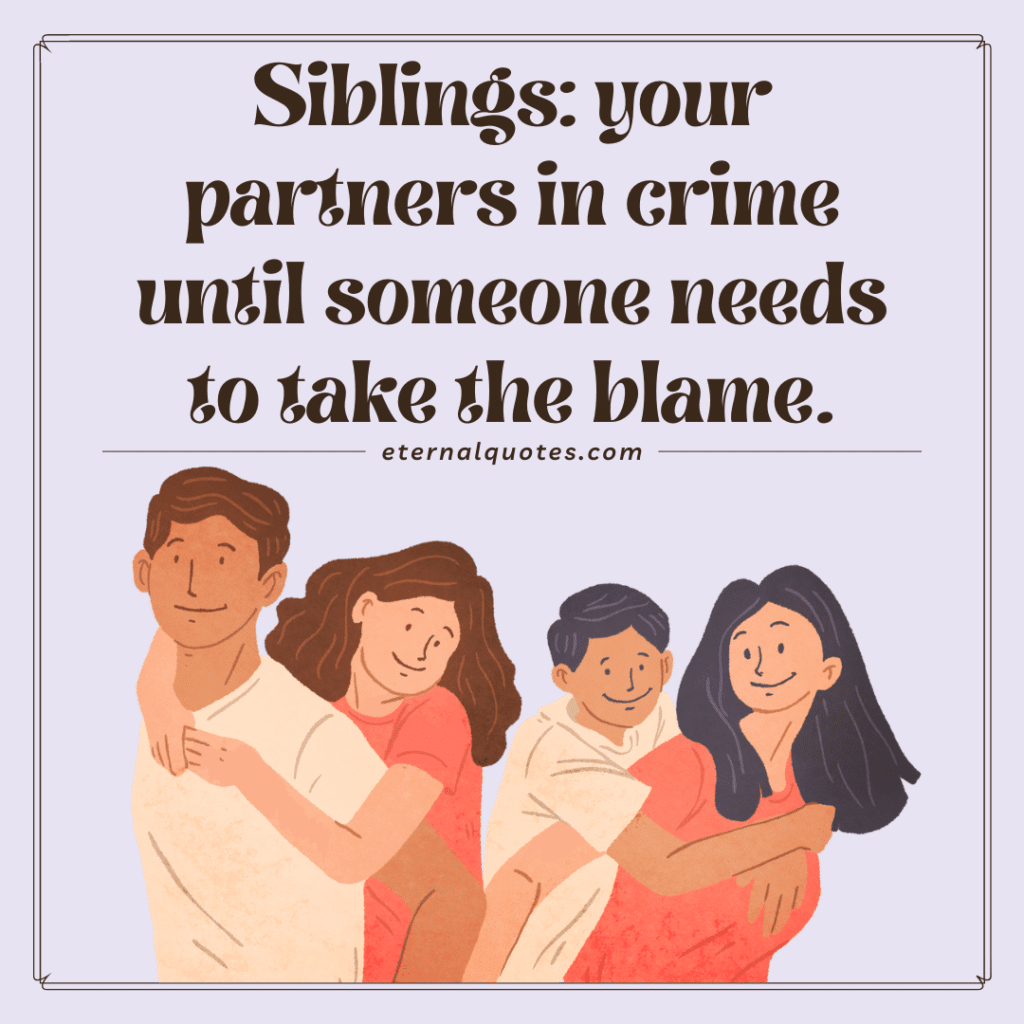
Nothing bonds siblings quite like keeping secrets from your parents.
Remember when we were kids and I used to bug you? I’m not sorry.
Having a sibling means always having someone to blame and someone to laugh with.
Our childhood was basically an unscripted comedy show.
The best pranks are the ones your siblings still don’t know you pulled.
Siblings know all your inside jokes and most of your passwords.
We spent our childhood laughing until we cried and crying until we laughed.
The longest-running comedy show is the one between siblings behind closed doors.
A shared glance across the dinner table can make siblings burst into laughter for reasons no one else understands.
My sibling and I created more mischief than our parents ever discovered.
Adult Siblings
Adult sibling relationships often carry a different kind of quiet than they did in childhood. The urgency fades, the roles loosen, and people begin to see each other with a little more clarity. What used to be constant contact may turn into occasional calls, messages, or visits that still hold real weight. Familiarity remains, but it often becomes steadier and more chosen.
There is something deeply grounding about growing older beside someone who remembers your beginning. Adult life can scatter people across cities, routines, and responsibilities, yet some connections keep their shape through all of that movement. A sibling may become less central to daily life and more central to a person’s sense of continuity. That quiet endurance is part of what makes the bond feel more valuable with age.
The older we get, the more we realize how valuable sibling relationships are.
Adult siblings: the only people who text “You won’t believe what mom just said.”
Growing old with siblings means having someone who remembers you as you were and loves you as you are.
As adults, we stop competing and start appreciating our differences.
Adult siblings: the people who remember your most embarrassing phases and love you anyway.
The beauty of adult sibling relationships is that now we choose to spend time together.
As we grow older, we realize our siblings are our longest-lasting friends.
A sibling becomes more precious as life progresses and parents leave us.
The best part of being adult siblings is that now we can complain about the same things together.
The greatest gift of adulthood is realizing your annoying sibling is actually your best friend.
What Stays With Us
Sibling relationships stay with people in ways that are often hard to measure. They shape the emotional language of early life, teaching closeness through repetition, conflict, comfort, and the long habit of sharing space. Even when those relationships change over time, they often remain threaded through a person’s memory. Certain bonds continue not because they are perfect, but because they were woven into the beginning.
What siblings give each other is rarely neat or easy to define. It can look like irritation, protection, competition, tenderness, silence, or laughter, sometimes all at once. That complexity is part of what makes the relationship feel real. Few connections hold so many contradictions while still managing to endure.
As people grow older, the meaning of those early ties often deepens. Things that once felt ordinary begin to carry more weight, especially the simple fact of being remembered by someone who was there from the start. In adulthood, that kind of shared history can feel almost rare. It becomes a form of continuity in a life that changes again and again.
Not every sibling relationship follows the same path, and not every bond becomes openly close. Some remain playful, some grow quiet, and some take years to soften into something more honest. Still, there is often a lasting imprint left by growing up alongside another person in the same family story. Even distance does not always undo that kind of influence.
The memories tied to siblings are often small ones rather than dramatic ones. Shared meals, family routines, private jokes, old arguments, and unspoken understandings tend to linger longer than expected. Over time, these details become part of a person’s inner landscape. They remind us that much of what shapes a life is built through ordinary closeness.
In the end, sibling bonds often matter because they carry both the weight of history and the possibility of renewal. They can be tested, stretched, and redefined without losing their depth entirely. What remains is the quiet knowledge that someone else holds pieces of the same beginning. That alone can make the connection feel lasting in a way few others do.