Just so you know – some links on this page are affiliate links. If you click and buy something, I may earn a small commission (think coffee money, not a luxury vacation) at no extra cost to you. I only share things I genuinely like and believe are worth it. Thanks for supporting this little corner of the internet – it really helps keep everything running.
Senior year has a particular quality to it — a kind of slow-burning awareness that something is ending even as it’s still happening. You walk the same hallways you’ve walked for years, and suddenly they look different. Not because they’ve changed, but because you have. That shift is subtle at first, then impossible to ignore. It settles in somewhere around winter and stays.
Most people spend their senior year caught between two feelings at once — relief and something that looks a lot like grief. You’re ready to leave, and you also know that whatever comes next will never feel quite like this again. That tension is worth sitting with. It doesn’t need to be resolved, just acknowledged. The people who understand that tend to choose better yearbook quotes.
A yearbook quote is a small thing, but it carries weight in a way that’s hard to explain. Years from now, someone will flip to your page and read it. Maybe they’ll laugh. Maybe they’ll nod. Maybe they’ll think, yeah, that was exactly who that person was. That’s really all you’re aiming for — a few words that feel honest to where you stood at this particular moment in your life.
Funny quotes have a long, proud tradition in yearbooks, and for good reason. Humor is one of the more reliable ways humans have of telling the truth without flinching. A well-timed joke about surviving four years of early mornings and group projects says something real. It says: I was here, I found it absurd, and I made it through anyway. That’s worth more than it sounds.

“I came, I saw, I left early.”
“BRB—just kidding, I’m never coming back.”
“High school was easy. It was like riding a bike. Except the bike was on fire, and I was on fire.”
“I’m 100% certain I have no idea what I’m doing.”
“I didn’t change, I just learned who I really was.”
When Sarcasm Is the Most Honest Language You Have
Sarcasm gets a bad reputation, but at its best it’s just honesty wearing a smirk. For a lot of students, the ability to joke about how exhausting, chaotic, or absurd high school was is exactly what got them through it. There’s a kind of emotional intelligence in being able to laugh at a situation without pretending it was something it wasn’t. That skill will serve people well beyond graduation.
The best sarcastic quotes don’t punch at anyone — they turn inward, at the experience itself or at the speaker’s own relationship with it. They’re self-aware without being self-pitying. They say, with a straight face, that surviving was the achievement, and there’s no shame in owning that. Sometimes the most dignified thing a person can do is refuse to perform a gravity they don’t actually feel.
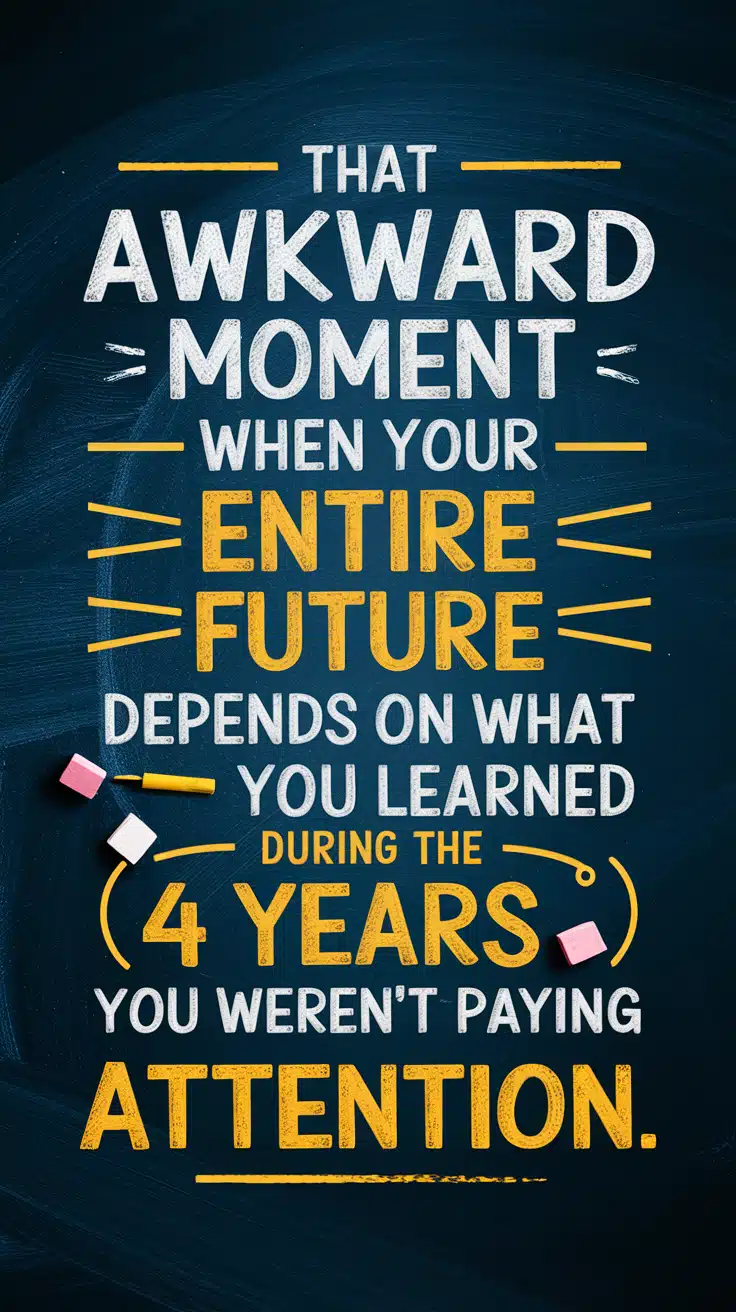
“Survived high school with minimal effort and maximum sarcasm.”
“This cap and gown were paid for by procrastination.”
“The future is bright, but first, let me take a nap.”
“Education is what remains after you forget everything you learned in school.”
“No more waking up at 6 AM? Now that’s a diploma worth celebrating!”
The Art of Getting Through It Anyway
There’s a particular kind of pride that comes not from doing something perfectly, but from doing it at all. Plenty of seniors cross that stage knowing they struggled — that there were mornings they almost didn’t show up, assignments they turned in at 11:58 PM, and tests they passed by margins they’d rather not discuss. Getting there anyway is its own form of accomplishment, and it deserves to be named.
Graduation doesn’t ask how gracefully you arrived — only that you did. Some students glide through with straight A’s and perfect attendance. Others piece it together week by week, scraping together enough momentum to keep going. Both end up at the same ceremony, in the same cap and gown. The ones who struggled hardest often have the most honest things to say about it.
“Shoutout to my brain for getting me through this. We struggled, but we made it.”
“I didn’t go to school for an education. I went to learn the best places to nap.”
“I graduated just to prove my teachers wrong.”
“Some graduate with honors, I am just honored to graduate.”
“They say high school is the best four years of your life. Well, that’s disappointing.”
Closing the Chapter Without Looking Back Too Hard
Endings are strange. They rarely feel the way you expect them to — there’s no dramatic music, no slow-motion walk across a field. Most endings feel more like a Tuesday than a finale. And yet something genuinely closes. A door you’ve been walking through every day for years quietly shuts behind you, and you realize you won’t be back.
Some people handle endings with ceremony and sentiment. Others handle them with a shrug and a one-liner. Neither approach is wrong. What matters is that you know, somewhere underneath the joke or the speech, what this moment actually meant. Carrying that awareness forward — lightly, without making too much of it — is a good way to move through the world.
“I was here. I did things. Now I’m leaving.”
“Straight outta high school.”
“If you’re reading this, I made it. Barely.”
“I started high school with no idea what was going on, and I’m leaving with no idea what’s going on.”
Owning the Awkward With a Straight Face
High school is, at its core, an exercise in awkwardness. Everyone is figuring out who they are while simultaneously being watched by everyone else who is also figuring out who they are. The students who can look back at that situation and laugh have usually developed something valuable — a comfort with imperfection that will carry them much further than any grade or award.
There’s real confidence in a quote that doesn’t try to dress things up. Admitting, in front of the whole graduating class, that you made it awkward or barely kept it together — that takes a certain ease with yourself. It suggests someone who has already made peace with not being perfect, and that kind of peace is worth more than it looks.
“I came. I saw. I made it awkward.”
“This is my greatest achievement… so far.”
“My GPA might not be the best, but my meme collection is elite.”
“If you can read this, you’re too close to my yearbook page.”
“I’d like to thank my alarm clock for never working properly.”
On Adulting, and Why Nobody Feels Ready
One of the funnier shared experiences of graduating is the sudden realization that adulthood was never something you trained for — you just aged into it. There’s no exam, no certificate, no moment where someone hands you a manual and says, here, this will explain everything. You simply find yourself holding a diploma and wondering if everyone else has a better grip on things than you do. For the record: they don’t.
The anxiety around what comes next is real, but so is the humor in it. Quotes that gently poke at the gap between expectation and reality — between what graduation is supposed to feel like and what it actually feels like — tend to age well. They capture something true about being 17 or 18 and standing at the edge of something enormous with no particular map.

“Does this mean I have to start adulting now?”
“Can I take a gap year from life?”
“If I had a dollar for every time I thought about dropping out, I’d still be broke, but less broke.”
“I was here for a good time, not a long time… oh wait.”
“First rule of high school: Never turn your back on group projects.”
Sleep, Survival, and Other Things That Kept You Alive
Sleep deprivation is practically a rite of passage in high school, and the students who made it through on caffeine and sheer stubbornness deserve acknowledgment. There’s something quietly absurd about a system that asks teenagers — whose bodies are biologically wired to sleep later — to be coherent and functional before 8 AM every single day for four years. Most managed. It wasn’t pretty, but they managed.
Humor about exhaustion, motivation, and getting by on fumes resonates because it’s almost universally true. When a quote lands on that shared experience, it creates a small moment of recognition — a sense that someone put into words exactly what everyone else was quietly living. That’s what the best yearbook quotes do, even the silly ones. They make the reader feel less alone in it.
“My motivation levels were directly proportional to the number of exams I had.”
“I learned a lot in high school… mainly how to function on no sleep.”
“It’s not the end, it’s just an intermission.”
“Insert something deep and meaningful here.”
“My biggest achievement? Finding ways to avoid gym class.”
Winging It, and the Strange Dignity in That
Most things in high school were figured out on the fly. The presentation that came together the night before. The test you studied for in the hallway fifteen minutes before the bell. The speech you made up halfway through delivering it. And yet somehow, it worked often enough to matter. There’s a lesson buried in that — something about trust, and resilience, and the fact that preparation is good but not always the whole story.
Admitting that you winged it is its own kind of honesty. It doesn’t mean you didn’t care — it often means you cared about the right things and let the rest go. The students who learned when to push hard and when to just show up and see what happens often turn out to be the most adaptable people in the room a decade later. They already know how to work with uncertainty.

“Dear diploma, I always believed in us.”
“High school: Where the food is bad, but the Wi-Fi is worse.”
“They say you become wise with age. So far, I’ve just gotten tired.”
“I’m not saying high school was hard, but I deserve an award for showing up.”
“Let’s be real, we’re all just winging it.”
The Underrated Wisdom of Not Taking It Too Seriously
High school trains students to treat everything as urgent — grades, rankings, social dynamics, the thing someone said about you in the hallway. Some of it matters. A lot of it doesn’t, and knowing the difference is something that takes most people years to sort out. The ones who already had some perspective on it, who could step back and smile at the machinery of it all, often carried themselves with more ease than their peers.
A quote that gently deflates the pompousness of graduation — the over-rehearsed seriousness of it all — can be more honest than one that reaches for significance. Not everything needs to be weighted with meaning. Sometimes “thanks, Google” says more about the reality of high school than any earnest speech about potential and futures. Both things can be true at once.
“I can finally use math in real life… said no one ever.”
“Achievement unlocked: Survived high school.”
“Goodbye school, hello debt.”
“Thanks, Google. I couldn’t have done it without you.”
“This wasn’t like High School Musical at all.”
Side Quests, Next Chapters, and Moving On
There’s something freeing about thinking of high school as a level you’ve cleared rather than the whole game. It reframes the experience — not as the peak of anything, but as one stage in something much longer and more interesting. That perspective makes the leaving easier. You’re not walking away from the best it gets; you’re walking into something that hasn’t shown you what it is yet.
Forward momentum doesn’t require certainty. Most of the people who went on to do interesting things had no idea what they were doing at graduation either. What they had was a willingness to keep moving — to take the next step even when the path wasn’t clear. That impulse, more than any plan or grade or extracurricular, tends to be what carries people somewhere worth going.
“Four years later, still don’t know where the library is.”
“Mission accomplished. Moving on to the next side quest.”
“High school was fun, but I’m never coming back.”
“It took 12 years to get here. I deserve a nap.”
What Showing Up Every Day Actually Costs
Consistency is underrated. Not glamorous consistency — the kind where everything goes smoothly and you’re always prepared — but the more ordinary kind. The kind where you show up tired, underprepared, unsure, and do what needs to be done anyway. That version of showing up is quieter and less celebrated, but it accounts for more of most people’s success than any single inspired moment ever could.
High school asks for that kind of consistency for four years straight, and most students deliver it without much fanfare. They get up, they go, they try, they come home and do it again. There’s no trophy for that. But graduation is, in its own way, the acknowledgment that it happened — that the accumulation of ordinary days added up to something real.
“High school: Where you learn how to pass, not how to succeed.”
“I’d like to thank my bed for always being there for me.”
“I survived. Barely. But I did.”
“Now accepting applications for my personal assistant.”
“This is the first time I’ve ever been on time for something.”
Senioritis, and Why It’s Practically a Coping Mechanism
Senioritis gets treated like a character flaw, but it’s really just the brain doing what brains do when they can see the finish line — easing up on the effort, redistributing energy, coasting a little. After years of sustained pressure, a semester of diminished enthusiasm for homework isn’t a moral failure. It’s a fairly reasonable biological response to the knowledge that it’s almost over.
The seniors who leaned into it with humor rather than guilt tended to enjoy their final months more. There’s something to be said for deciding, consciously, that you’re going to find the absurdity in the final stretch rather than fight it. That decision — to meet the end of something with lightness instead of strain — is a skill that will come in handy many times over.
“If senioritis were a class, I’d get an A+.”
“I’ll miss high school like I miss waking up early—never.”
“I learned a lot. Mostly how to fake understanding things.”
“You’ll miss me when I’m famous.”
“The best part of high school? Leaving.”
Procrastination as a Lifestyle, Graduation as a Miracle
Procrastination has a reputation, but most people who lived inside it know it’s more complicated than laziness. There’s often a kind of perfectionism underneath it — a reluctance to start something until the conditions feel right, which they almost never do. High school procrastinators frequently turn out to be people who work well under pressure, who think clearly when the stakes are real and the deadline is immediate. That’s not nothing.
Making a joke about procrastination in a yearbook quote is a way of owning a trait rather than hiding it. It signals self-awareness — an understanding that this was a pattern, it had costs, and somehow the diploma happened anyway. That combination of honesty and humor is quietly endearing, and it tends to read well on the page years later.
“Zero days late, zero classes skipped, and zero regrets. Just kidding.”
“Graduating: The only thing I didn’t procrastinate.”
“Bye, school. I won’t miss you.”
“I finally understand that one Spongebob meme.”
“When nothing goes right… go left.”
Checked Out, Moving On, Leaving Anyway
There’s a specific senior experience of being mentally done months before the actual end. Your body shows up, your name gets called, but your attention is already somewhere else — somewhere warmer, more interesting, less structured. That early departure of the mind is its own kind of graduation. You’ve already decided you’re ready, and no amount of remaining assignments can fully pull you back.
Quotes that capture that particular checked-out energy are some of the most beloved in yearbooks, because almost everyone has felt it. The person who names it — who says, plainly, I was already gone before I left — speaks for a lot of people who didn’t have the nerve to put it in writing. That’s its own kind of service to the graduating class.
“So long, and thanks for all the fish.”
“Taking this diploma to the bank… oh wait.”
“Why fall in love when you can fall asleep?”
“I’d like to thank my caffeine addiction for getting me through this.”
“If you’re reading this, I’m already gone.”
What Comes After the Tutorial Level
The game metaphor for high school works surprisingly well. The stakes feel enormous while you’re in it, but in retrospect the rules were clear, the objectives were spelled out, and there was always someone nearby to tell you what to do next. Real life doesn’t work quite like that — the objectives are self-generated, the feedback loops are slower, and there’s no bell to tell you when one period ends and another begins.
That ambiguity is uncomfortable at first, but it turns out to be where most of the interesting things happen. The absence of a fixed structure is also the absence of a ceiling. Without assigned seats and predetermined categories, people find out what they actually care about — and that discovery, slow and sometimes disorienting as it is, tends to be the most important education anyone gets.
“Let’s skip to the part where we’re rich and successful.”
“I peaked in kindergarten.”
“High school was my longest relationship.”
“I’m outta here like a bald man in a hurricane.”
“If life is a game, I just finished the tutorial.”
Fake It Till You Graduate
Impostor syndrome doesn’t wait until the workplace to show up — it starts in high school, in the gap between how confident everyone else looks and how you actually feel on the inside. Most students spend four years quietly convinced that they’re the only one who doesn’t really know what’s going on. They’re not, of course. That gap between appearance and reality is almost universal, which is part of why it’s so funny when someone names it directly.
Quotes that play with the “fake it” theme tend to connect with people precisely because they’re confessing something everyone already knows. They strip away the performance of having it together and replace it with something more honest: the acknowledgment that most of us are making educated guesses most of the time, and that’s okay. The diploma is proof that the guesses were good enough.
“Proud graduate of the ‘fake it till you make it’ program.”
“Not all those who wander are lost, except me in algebra class.”
“Dear future self, remember to sleep more.”
“Catch me if you can… but you probably won’t.”
“I spent most of high school looking for my other sock.”
Cap, Gown, and Absolutely No Plan
There’s a particular comedy in graduation ceremonies — the formality of it, the robes, the speeches, the handshakes — when so many of the people walking across that stage have no concrete idea what happens on Monday. The ceremony is grand; the reality is considerably more uncertain. That contrast is worth a smile, and the students who clock it are usually the most honest people in the room.
Not having a plan is not the same as having no future. Some of the most interesting paths people take begin with an open schedule and a vague sense of direction. The uncertainty itself can be generative — it forces decisions that a neat, predetermined plan would have made for you. There’s something to be said for standing at the edge of things without a map and deciding to walk forward anyway.

“I survived high school, but will I survive adulthood?”
“See you all at the 10-year reunion… or not.”
“This is the beginning of whatever I want.”
“I majored in surviving.”
“If life gives you lemons, sell them and buy pizza.”
Left Unsupervised, and What Became of That
High school involves a strange in-between relationship with supervision — too old to be managed like children, too young to be fully trusted, navigating a middle space where the rules were enforced unevenly and the freedom was always partial. Students learned, in that space, how to make decisions without a lot of guidance. Some of those decisions were excellent. Others were instructive in different ways.
The chaos of those years — the questionable choices, the things that definitely should not have worked out but somehow did — is part of what makes the graduating class feel like a unit. Everyone has their version of the story that starts with “we were left unsupervised.” Those stories are usually the ones people tell longest and laugh at hardest, because they contain something true about what it was like to be young and figuring things out without a manual.
“Becoming an adult sounds expensive.”
“No, I didn’t study. No, I don’t regret it.”
“Here’s to the nights we won’t remember with the friends we won’t forget.”
“High school felt like a 4-year-long escape room.”
“In my defense, I was left unsupervised.”
Still No Clue, Officially Certified
There’s a comedy specific to overdue library books, pajamas worn as a fashion statement, and spending four years preparing for something you still can’t quite name. These aren’t failures — they’re textures. They’re the details that make a high school experience feel lived-in rather than performed. The students who notice those details and find them funny tend to have a good relationship with their own imperfection, which is a valuable thing to carry forward.
Being “officially too cool for school” is the kind of thing that reads differently at 18 than it will at 28 — but in the best way. Years from now, that same person will flip back to their own yearbook page, read what they wrote, and either laugh or nod or wince slightly. All of those reactions are good. Any quote that provokes a genuine human response, even decades later, has done its job.
“Leaving behind four years of memories… and a few overdue library books.”
“They said dress for the job you want. Guess I’m staying in pajamas forever.”
“I was going to put something deep, but then I changed my mind.”
“Officially too cool for school.”
“I spent four years preparing for this moment… and I still have no clue what’s next.”
Running Late for the Next Adventure
Some quotes arrive at wisdom by accident — phrased as jokes, structured as deflections, but containing something real if you hold them up to the light. “I understood the assignment. Barely.” is funny, but it’s also a small portrait of someone who was paying attention even when they seemed not to be. That combination — irreverence and genuine engagement — is more common than people think, and it tends to produce interesting people.
The quotes that survive the longest in people’s memories are the ones that felt true at the moment they were written. Not aspirational, not curated, not written for an imagined future audience — just honest about who the person was in that particular spring of that particular year. That honesty is harder to pull off than it sounds, and the students who manage it have already learned something most people take years to figure out.
“I understood the assignment. Barely.”
“Dream big, work hard, take naps.”
“If you don’t know where you’re going, at least make sure you have good snacks.”
“Reality called. I hung up.”
“This is not a goodbye, it’s just an ‘I’m running late’ for the next adventure.”
What You’re Actually Taking With You
Graduation is celebrated as an arrival, but it’s really a departure — the moment you stop being defined by one place and start figuring out what you are beyond it. That’s quieter than the ceremony suggests. Most of what you’re taking with you isn’t in the diploma or the transcript. It’s in how you learned to talk to people, how you handled something hard, what made you laugh when things were difficult, who stood next to you when they didn’t have to.
The skills that matter most from these years are often invisible on paper. Knowing how to read a room. Knowing when to ask for help and when to push through on your own. Knowing how to find something funny about a situation that is genuinely terrible. These weren’t on any syllabus, but they were taught every day, in the hallways and cafeterias and parking lots, in all the spaces between the official curriculum.
High school humor, at its best, is a form of emotional intelligence. The student who can write a joke that makes three hundred people simultaneously recognize themselves is doing something that most adults spend careers trying to learn — communicating honestly, with precision, in a way that connects rather than distances. That’s not a small thing. It doesn’t look like a skill, but it is one.
Whatever quote you choose — or chose — it will eventually become a small artifact of a specific version of yourself that no longer exists. That’s not sad. It’s just how people work. You’ll grow past it, and that growth is the whole point. The quote doesn’t need to capture who you’ll become. It only needs to be honest about who you were standing in that particular gymnasium, holding that particular diploma, on that particular afternoon.
There’s something quietly valuable in the students who didn’t take themselves too seriously. They moved through high school with a lightness that made them easier to be around and, often, easier on themselves. That lightness isn’t the same as not caring — it’s a way of caring without being crushed by it. It’s a way of holding the weight of things without letting that weight become the whole story.
Whatever comes next, the people who made it through those four years carrying a decent sense of humor about themselves and the world are generally in good shape. Not because humor solves anything — it doesn’t — but because it keeps things in proportion. It’s a way of saying, even in the middle of something hard: I see this clearly, I am not destroyed by it, and I’m still moving forward. That’s a reasonable way to enter whatever comes after the diploma.